

Since the announcement of a new round of direct talks betweenLebanonandIsraelscheduled for Thursday, following afirst meeting in Washingtonin early April, Lebanese PresidentJoseph Aounand Prime MinisterNawaf Salamhave been the targets of a smear campaign orchestrated byHezbollahsupporters.
Read moreMiddle East war live: Trump issues 'shoot and kill' orders for boats laying mines in Strait of Hormuz
The head of state, who is banking on the talksto secure an Israeli army withdrawal from southern Lebanonand a final demarcation of the shared border, was even the target of an implicit death threat issued by officials from the Shia party.
The threat was taken seriously inBeirutgiven the pro-Iranian movements track record, with several of its members convicted by the UN Special Tribunal for Lebanon (STL) over the 2005 assassination offormer prime minister Rafic Hariri.
Senior Hezbollah official Nawaf Moussaoui warned in an interview with the party's Al-Manar television channel on Saturday that if the Lebanese president "wants to take decisions unilaterally, he is no more important than Anwar al-Sadat" a reference to the Egyptian president whowas assassinated in 1981, three years after signing a peace deal with Israel at Camp David.
Moussaoui added that any negotiation or agreement between Israel and Lebanon would be "rejected, unrecognised and thrown in the bin, like the May 17, 1983 agreement".
A deal that never took effect
That security agreement never implementedwas officially signedby Israel and Lebanon under US auspices at Khaldeh, near Beirut, during the Lebanese civil war (1975-1990). Lebanon, then led by President Amine Gemayel (1982-1988), was at the time simultaneously occupied by both the Israeli and Syrian armies.
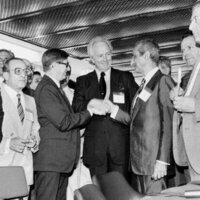
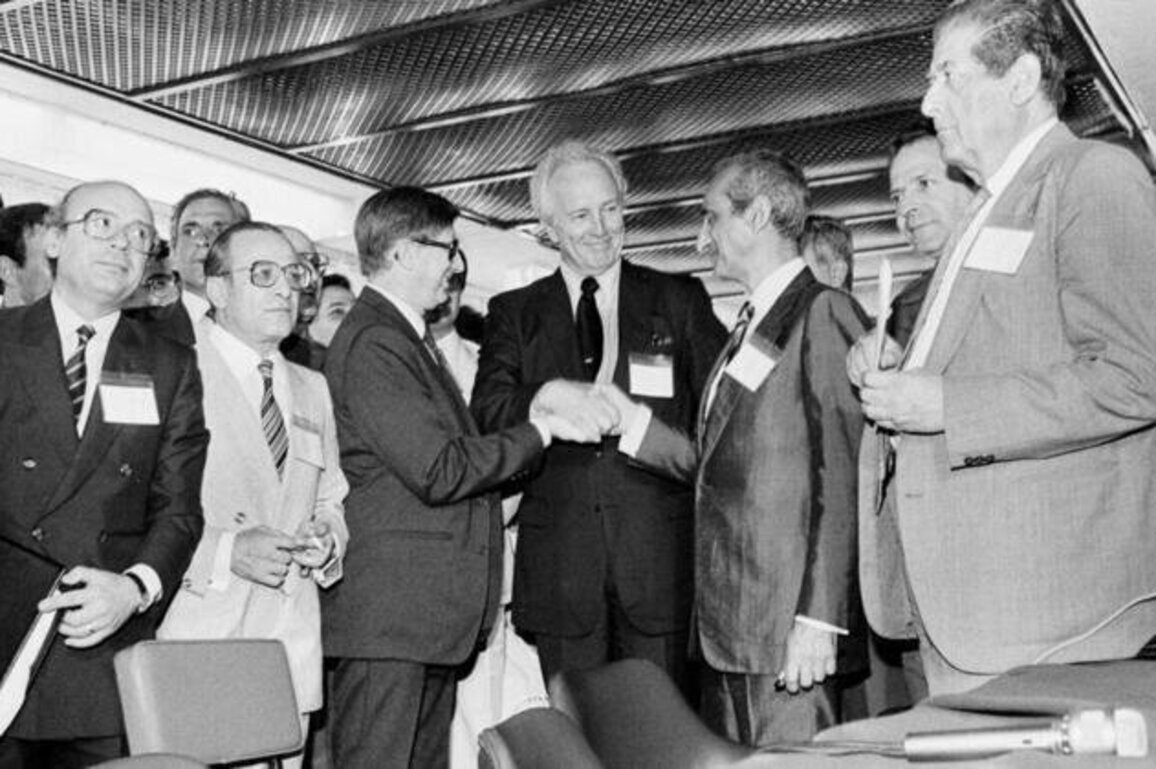
Ambassador Antoine Fattal headed the Lebanese delegation, while the Israeli team was led by diplomat David Kimche, with both sides facing US President Ronald Reagan's envoy Morris Draper, Under-Secretary of State for Near Eastern Affairs.
The deal resulted from 35 Israeli-Lebanese meetings in late December 1982 and held alternately in Lebanon and Israel. Comprising a dozen articles, it was meant to be a first step towards lasting peace between the two countries.
Its preamble proclaimed "the termination of the state of war" between the two neighbours, who under article 2 committed to "settle their disputes by peaceful means".
Chief Israeli negotiator David Kimche, right, gestures as he speaks with Antoine Fattal, Lebanon's chief negotiator in Khalde, Lebanon, on March 1, 1983.
The text provided for the creation of a security zone in southern Lebanon, a timetable for the withdrawal of Israeli forces and a commitment by each side not to allow its territory to be used as a base for "hostile or terrorist activity" against the other.
It even suggested future negotiations on "agreements on the movement of goods, products and persons and their implementation on a non-discriminatory basis".
Although ratified by the Lebanese parliament, the agreement was never promulgated by President Gemayel. In March 1984, it was abrogated by the council of ministers under pressure from Syrian President Hafez al-Assad and his Lebanese allies at the time Druze warlord Walid Joumblatt and Nabih Berri, head of the Shia Amal militia and Lebanon's parliament speaker since 1992 all of whom were hostile to any agreement with Israel.
Assad, with no small irony, told Gemayel that the abrogation was "a victory for the peoples of Syria and Lebanon and of the entire Arab nation" and that his country would "remain at Lebanon's side in its struggle for independence and sovereignty" even as his army remained an occupying force in the country.
In a recent interview with the daily newspaperL'Orient-Le Jour, the former Lebanese president said Israel had not genuinely wanted to implement the May 17 agreement either, accusing it of having added "at the last minute, clauses to the previously negotiated text", including one requiring a simultaneous Syrian withdrawal from Lebanon effectively givingDamascusveto power.
"It was a way of giving Damascus a veto," he said. "Especially since we had no control over the decision on the withdrawal of the Syrian army."
Read moreSelf-destructive, suicidal: In Lebanon, anger rises against Hezbollah amid Israeli strikes
An Iranian veto?
Asked about this Lebanese-Israeli precedent in relation to the current situation, Sami Nader, director of the Institute of Political Science at Saint Joseph University in Beirut, pointed to a regional context entirely different from that of 1983.
At the time, only Anwar al-Sadats Egypt had signed a peace agreement with Israel, he explained, noting that the UAE, Bahrain,Moroccoand Sudan later joined the Abraham Accords under US PresidentDonald Trump, while Jordan had signed a peace treaty in 1994. Today, even Syria, which was once the main obstacle to the May 17 agreement, is ready to sign with the Israelis.
Syrias interim president Ahmed al-Charaa said on Friday at adiplomatic forum in Turkeythat he was open to direct negotiations with Israel over the occupiedGolan Heightsif a security deal guaranteed Israeli withdrawal from recently occupied Syrian territories.
"In 1983, Hezbollah, which had just been founded, did not yet have a say in Lebanon. Today it is the main obstacle to such negotiations, as is its Iranian patron, which opposes regional normalisation efforts with Israel," Nader said.
Direct talks between Lebanon and Israel would deprive Tehran of leverage, he added, because Iran wants Lebanon through Hezbollah to remain a strategic card.
A 'yellow line' that 'instils doubt'
Nader also noted a "fundamental difference" between theIsraeli invasion of 1982and the current one, "due to the famous yellow line drawn by the Netanyahu government, isolating part of the territory, devastated and emptied of its population".
Israeli authorities say theyhave drawn a "yellow line"deep inside southern Lebanon, claiming it is intended to protect northern Israeli communities from Hezbollah fire.
In Lebanon, the buffer zone stretching hundreds of square kilometres from the Mediterranean coast to the Lebanese-Syrian border is widely seen as a new unilateral border drawn by Israel.
In Gaza, a similar yellow line established after the October ceasefirecuts the territoryfrom north to south between a Hamas-controlled zone and another effectively controlled by the Israeli army.
Watch moreGaza faces Israels yellow line
This yellow line "instils doubt about Israeli intentions", Nader insisted. "Because it is reminiscent of a scenario already seen in the Syrian Golan a scenario of annexation and no observer can rule out that possibility with the far-right government currently leading Israel."
"Even more than President Gemayel in 1983, President Aoun seems to believe that the only way for Lebanon to rule out such a scenario is to negotiate, that is, to seek peace, and therefore in a sense the disarmament of Hezbollah, in exchange for the conquered territory," he concluded.
"Because the other option, the military one advocated by the Shia party, allows the Israelis to justify their occupation of southern Lebanon."
This articlewas translated from the original in Frenchby Analle Jonah.
Originally published on France24