

On May 22, 2025, the US accused the Sudanese army of using chemical weapons in its war against the Rapid Support Forces (RSF) militia. The US presented no evidence to support the allegations, which the Sudanese army denied. But the FRANCE 24 Observers team has documented two incidents in September 2024, north of Sudans capital Khartoum, where video evidence shows that barrels containing chlorine were dropped from the air. International law bans the use of chlorine gas as a weapon.
On April 24, 2025, the United States determined that the Government of Sudan used chemical weapons in 2024. This is how the US State Department opened itsMay 22, 2025, statementannouncing economic sanctions against the Sudanese government, which is under military control. No further details were provided to support the decision.
Khartoumdeniedthe allegationsthe following day.
TheNew York Timeshad cited US officials in January as saying that the Sudanese army had used chemical weapons that appeared to use chlorine gas against the RSF (Rapid Support Forces) militia on at least two occasions in 2024. The officials gave no details.
Following the US sanctions announcement, several Arabic-language media outletsechoed these accusations.Unverified rumoursandpostshave circulated in Sudan, including claims of chemical weapons use in Khartoum. But until now, no documentary evidence of the armys use of chlorine gas or any other chemical weapon has been made public.
Using open-source investigation techniques (OSINT), the FRANCE 24 Observers team in Paris examined two incidents in September 2024 in and near the al-Jaili oil refinery, north of Khartoum, which the army was attempting to recapture from the RSF. After reviewing images of the attacks gathered by the Observers, five experts confirmed they were consistent with aerial drops of chlorine barrels. Only the Sudanese army possesses the aircraft needed for such bombardments.
The Observers team also traced the origin of one of the chlorine barrels used in the attacks. Imported from India by a Sudanese company that provides supplies to the Sudanese army, the chlorine was intended, according to the Indian exporter, solely for treatment of drinking water. Chlorine is a much-needed humanitarian product in Sudan, critical for purifying water in a country prone to cholera outbreaks.
The military use of chlorine would place Sudan among the few regimes to have deployed this rudimentary lethal gas since World War I, during which it wasused on a large scale. More recently, during the Syrian civil war, the world chemical watchdog, the Organisation for the Prohibition of Chemical Weapons(OPCW), foundreasonable groundsto conclude that Bashar al-Assads regime used weaponised chlorine in rebel-held areas.
The two documented attacks in Sudan would also constitute a breach of the country'sinternational obligationsunder theChemical Weapons Convention, which it ratified in 1999. The use of asphyxiating, poisonous or other gases on the battlefield is also classified as a war crime under the1998 Rome Statute, which defines offences that the International Criminal Court (ICC) can prosecute though Sudan does not recognise the courts jurisdiction.
At the time of publication, neither the Sudanese army nor the government had responded to FRANCE 24's requests for interviews.
The al-Jaili refinery was the target of chemical attacks: RSF
Following the announcement of the US sanctions in May, pro-RSF accounts on social media circulated images which they claimed showed the Sudanese armys use ofchemical weapons.
Some of these postsalleged that the attacks had taken place at the al-Jaili refinery in September 2024. The facility, which processes crude oil, is located 60 kilometresnorth of Khartoum. Operated in peacetime by the state-owned Khartoum Refinery Company, it is thelargest refinery in Sudanand critical to the countrys fuel supply.
The country's civil war has disrupted the normal operation of the refinery. The RSFoccupied itsoon after the war began in April 2023, and a petroleum workers union said in May 2024 that it had beenout of servicesince July 2023. The Sudanese armyrecaptured the facility on January 25, 2025, aftermonths of heavy fighting.
On September 13, 2024, at the height of the clashes over control of the refinery, the RSF issued astatementaccusing the Sudanese army of targeting the site with an aerial bombardment by warplanes, using missiles suspected of being fitted with toxic gas, causing injuries and severe respiratory distress among dozens of workers.
In the previous days, videos had circulated on pro-RSF accounts showing two yellow and green barrels found near the refinery.
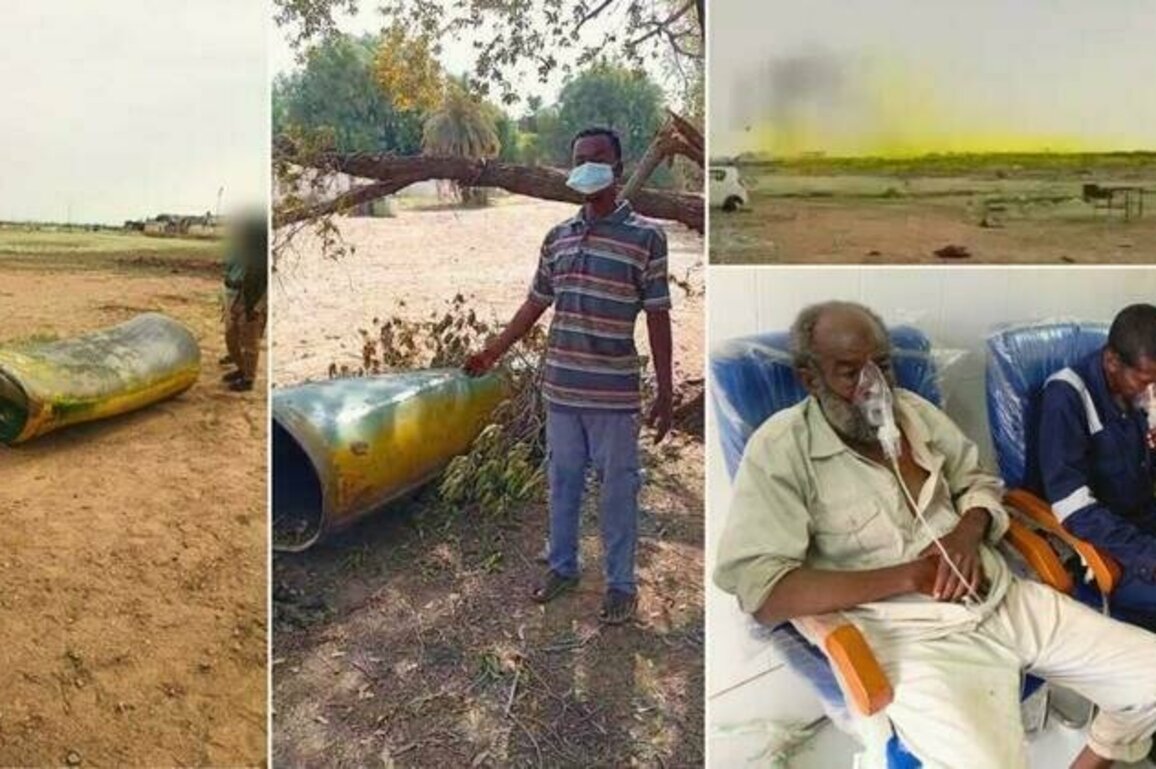
A video published on Instagram on September 5, 2024 showeda barrel lying on sand, with a caption in Arabic: The Sudanese armys air force strikes civilians with weapons banned under international law, loaded with toxic and chemical gases. Videos posted on September 13, 2024 showeda similar barrel beneath a tree.
Other posts from the same day showed workers receiving oxygen treatment.
The Observers investigated the images to verify the RSFs claims. Our team was able to geolocate the two barrels. The first was in a military base that had been occupied by the RSF, five kilometres east of the refinery. The second was within the refinery itself.
September 5: A barrel and a yellow cloud in an RSF-held base
On September 5, 2024,a pro-RSF accountposted a one-minute video on Instagram showing an arid landscape surrounded by buildings. A visibly damaged barrel can be seen, bearing a yellow label with the words: Oxidising agent 5.1.
Asecond video, posted on May 23, 2025, following the announcement of US sanctions, shows the same barrel from a different angle. A man first films a small crater in the ground, then a barrel a few metres away. He says:
Another video documents the moment when this something yellow is said to have escaped from the barrel. It shows acloud of that colour, filmed at the same location as the crater and the barrel. Although the only available version of the video dates from May 2025, it was likely filmed just before the barrel footage. A logo on the video indicates that it was originally posted by apro-RSF propaganda account on X, now deleted but still active onTikTok.
All three videos were filmed inside the Garri military base, located 5 km east of the al-Jaili refinery.
The Observers also obtained images of the incident that were not posted on social media. Filmed from different angles, they show men in RSF uniforms, confirming that the base was under militia control at the time of the incident and therefore a strategic target for the army. Metadata from the photographers phone indicate that the images were recorded September 5, 2024 at 8:07 in the morning.
A barrel designed to carry chlorine gas
Although those who filmed the barrel claimed it had released some kind of tear gas, experts say it contained a much more dangerous substance: chlorine.
These are clearly chlorine cylinders, said Dan Kaszeta, a specialist in chemical defence. This type of container is used all over the world for water treatment.
Unlike many other chemical weapons, chlorine is widely used in industry. When released into the air, however, it causes rapid suffocation and can be lethal. It is what we call a dual-use good its use determines whether it becomes a weapon, explained Matteo Guidotti, a chemist and chemical weapons expert.
Frederik Coghe, a ballistics expert and professor at the Royal Military Academy of Belgium, confirmed that the images from the Garri base show an industrial chlorine barrel.
The footage of the barrel also shows a date, 20/5/24, and a circular metal plate bearing a serial number: GC-1983-1715.
The Observers traced this GC-1983-1715 barrel to an Indian exporter, Chemtrade International Corporation. The company confirmed that the barrel was tested for the last time on May 20, 2024, the date indicated on the barrel. A shipping document indicates that it was part of a consignment of 17 cylinders filled with liquid chlorine that were loaded onto a vessel in Mumbai on July 14, 2024 for delivery to Port Sudan. An e-mail received by Chemtrade indicates that the cargo was delivered in Port Sudan on August 17, 2024. The Indian supplier said the Sudanese importer had assured them the cylinders would be used solely for drinking water treatment.
A low-hanging yellow cloud consistent with chlorine gas
Witness reports of a yellow gas leaking from the barrel and video footage showing a cloud of that colour spreading in the area further support the hypothesis of a chlorine attack.
Three experts consulted by the Observers confirmed that the cloud is consistent with a chlorine leak. Its colour is almost identical to what was observed in Aqaba, Jordan, said Guidotti. On June 27, 2022,a chlorine container fellfrom a transport ship at Aqaba port, causing a massive release of gas that killed at least 14 people and injured 256 others.
The colour of the cloud is consistent with what we would expect to see if chlorine gas was used, with a distinctive greenish-yellow colour, added N. R. Jenzen-Jones, director ofArmament Research Services(ARES), a technical intelligence consultancy specialised in arms and munitions. The cloud also exhibits the characteristics of a gas that is denser than air, hanging low over ground. That, too, is consistent with chlorine gas, he said.
September 13: A toxic substance inside the refinery
Other videos shared by pro-RSF accountson September 13, 2024eight days after the first incident show a similar barrel, this time beneath a tree. Men present at the scene filmed the object from several angles. One of them denounced what he described as the same type of attack as the one at the Garri military base.
Another videoshowing the same barrel, filmed by a second man, alleged that the consequences of the attack had been far more serious:
Footage shared on social mediaon September 13shows at least six men some wearing refinery uniforms receiving oxygen treatment. There is, however, no indication of deaths or serious injuries linked to the incident.
The videos showing uniformed men affected by the incident were filmed at therefinerys staff clinic.
Other images provided by witnesses allowed the barrel-under-the-tree footage to be geolocatedinside the refinery itself, among corrugated-roof buildings that appear to be workers' housing quarters.
People were unconscious, or struggling to breathe
The Observers spoke with a former engineer who was inside the refinery on September 13,along with many other workers. For his safety, his name has been withheld. Now living abroad, he provided evidence of his employment at the al-Jaili refinery, as well as screenshots showing that he had reported the incident to contacts on the morning of September 13. By phone, he said:
The engineers account is consistent with the images and witness statements posted online. He also said that some of the victims died after the incident. The Observers team was unable to confirm this allegation, and no other sources mention any deaths in connection with the two incidents.
Chemical weapons specialist Dan Kaszeta also expressed caution about these assertions and the symptoms shown in the oxygen-treatment footage:
The state of the barrels 'consistent with a drop from high altitude'
Accounts of an airdrop are corroborated by the videos of the event, in which several people refer to air force bombardments.
Jenzen-Jones also considers this scenario plausible:
Visual clues also support the idea that the chlorine barrels found at the Garri military base on September 5 and inside the al-Jaili refinery on September 13 were dropped from the air. For example, the barrel at al-Jaili brought down branches from the tree above it as it fell.
The barrel found at the Garri base shows soil embedded in several dents, suggesting they were caused by a violent impact with the ground.
The Observers showed these images to Frederik Coghe, a ballistics expert and professor at the Royal Military Academy in Belgium. His assessment:
This analysis was echoed by Trevor Ball, a former US army explosive ordnance disposal technician who now runs an open-source investigationaccount on X:
The Sudanese army is the only force in the country with the aerial military capacity to carry out airdrops of chlorine barrels which weighmore than a tonne. RSF forces only havedronesfor bombings, which cannot carry loadsexceeding 130kg.
While the army recently targeted cargo planes at the RSF-heldNyala airportin South Darfur, these aircraft were used solely for transporting troops and military equipment. There has been no documented evidence of the RSF conducting airstrikes with planes or helicopters, or using such aircraft for combat purposes.
'The explosion of any chlorine gas container will kill them slowly and silently'
Airdrops of these barrels were documented on social media by pro-RSF accounts from September 2024, but were also reported by outlets and channels favourable to the army.
On September 14, 2024, the day after the barrel fell inside the refinery, a pro-army media outlet claimed: Army aviation is attacking groups of militia fighters in the housing units of engineers and technicians at the al-Jaili refinery. A Telegram channel that supports the Sudanese armed forces and counts nearly 300,000 followers also reported air strikes on al-Jaili onSeptember 13. That same channel had earlier announcedstrikes on the refineryon September 4, only hours before the incident at the Garri military base.
Other posts on the Telegram channel hinted that toxic gas had been released at the refinery. Heavy artillery fire and air bombardments on the al-Jaili refinery by Antonov aircraft and fighter jets. The environment will become unbearable there with the build-up of gases resulting from burning oil and chemical substances The explosion of any chlorine gas container will kill them slowly and silently, read one message from the channel onSeptember 10.
Two days later, on the eve of the al-Jaili incident, the same account boasted: Resounding success in the testing of small boum-ban in the area. The claws [a nickname for RSF fighters] did not last more than 120 seconds. The term boum-ban ( in Arabic) is used in Sudan to describetear-gas bombsand appears to be an oblique reference to munitions employing gas. Men at the Garri base on September 5 used the same local term when talking about the chlorine barrel.
Two incidents compatible with chlorine attacks, according to five experts
Our investigation has found that industrial chlorine containers were dropped from the air on at least two occasions in the vicinity of the al-Jaili refinery, on September 5 and 13, 2024. At the time, the refinery was the scene of heavy fighting between the RSF and the Sudanese army.
According to RSF statements andpro-army posts, the army regularly bombarded the refinery and its environs in September 2024.Videosposted at the time show fires and substantial damage inside the complex. The army hasconsistently deniedcarrying out strikes on al-Jaili, instead accusing the RSF of destroying the refinery while occupying it by setting deliberate fires.
Five specialists in chemical weapons and ballistics consulted by the Observers all said that the images from Garri on September 5, 2024, and from the al-Jaili refinery on September 13 are compatible with chlorine gas attacks. They noted, however, that these indicators fall short of conclusive proof, and said that definitive verification would require immediate access to the sites. Guidotti noted:
Kaszeta expressed similar caution:
Jenzen-Jones struck a slightly different tone:
Sudanese government: 'There is no evidence of chemical or radioactive contamination in Khartoum State'
The Observers contacted the Sudanese army and government for comment. We also attempted to reach the US State Department to determine whether the sanctions announced in May 2025 were based on the incidents of September 5 and 13, 2024, at al-Jaili. A State Department spokesperson declined to comment, saying: As is standard practice, we do not comment on alleged intelligence reports or discuss internal deliberations.
After the US sanctions were announced on May 22, 2025, the army-controlled Sudanese government said it had formed acommitteeto investigate the accusations of chemical weapons use. TheSudanese health ministry, however, published a report in early September stating there was no evidence of chemical or radioactive contamination in Khartoum state, where the al-Jaili refinery is located.
If the use of chemical weapons is confirmed, those responsible both the perpetrators and decision-makers could face criminal liability, including before the International Criminal Court if the UN Security Council so decides, said Julia Grignon, an international law specialist and scientific director at theInstitut de Recherche Stratgique de lEcole Militaire, a research institute affiliated with the French Ministry of Defence. That has been done before: an arrest warrant was issued in 2009 for former Sudanese president Omar al-Bashir. Sudan does not recognise the ICCs authority: despite the warrant, al-Bashir was never extradited and remains detainedin his country.
But how did these Indian industrial chlorine barrels end up in Sudan, to be used as chemical weapons? To answer that question, the Observers traced their path. Our investigation found that they were initially purchased by a company with ties to the Sudanese army, importing products manufactured by firms specialising in military equipment and weaponry.
Coming soon:Chemical weapons in Sudan 2/2: how did chlorine meant for water purification end up being used as a chemical weapon?
This article has been translated fromthe original in French.
Originally published on France24