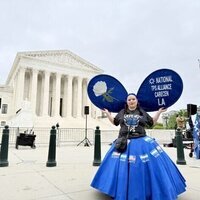


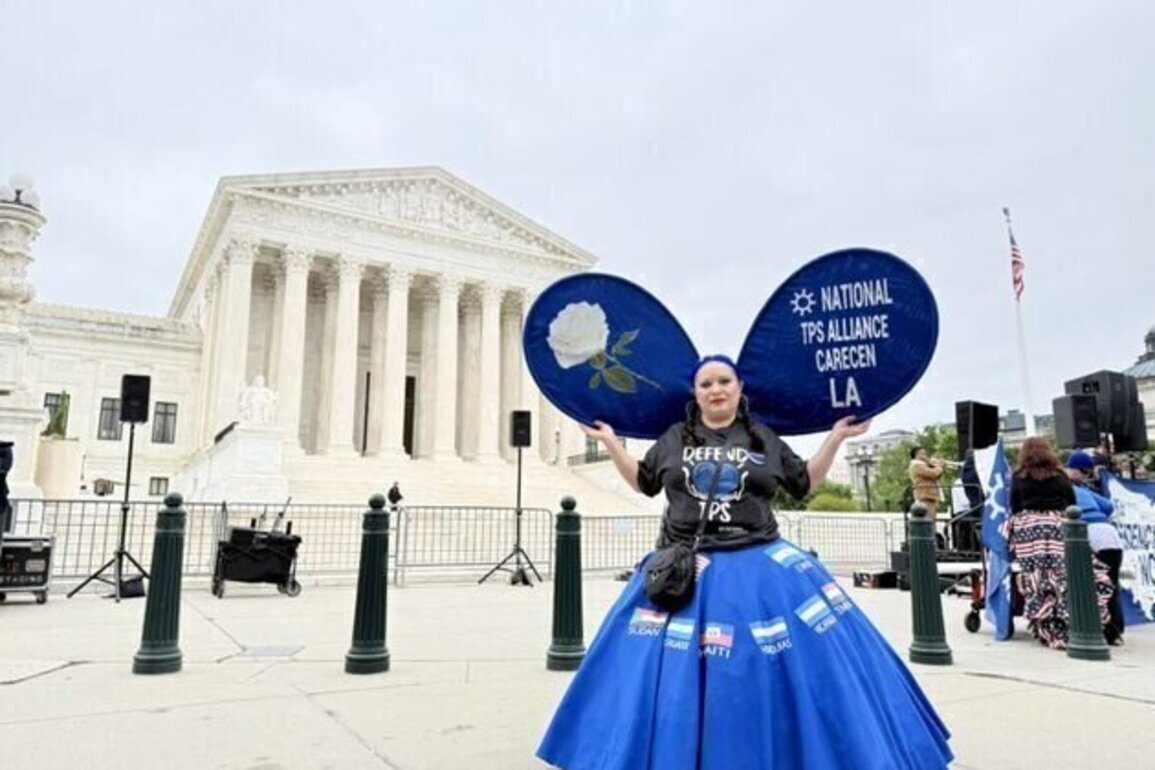
WASHINGTON (CN) - A group of musicians strummed an upbeat melody on a small stage in front of the U.S. Supreme Court Wednesday as the justices gathered to decide the fate of hundreds of thousands of migrants in the imposing marble palace at their backs.
Los Jornaleros del Norte, or the Day Laborer Band, joined advocates from the National TPS Alliance to rally in favor of Haitian and Syrian migrants with temporary protected status at risk of being sent back to perilous conditions in their home countries.
But as storm clouds gathered overhead, lawyers for the migrants faced tough questions inside the courtroom. Several of the conservative justices were concerned about the cascading effects of allowing them to challenge the Trump administration's decision to terminate their country's temporary protected status, known as TPS.
"If we depart from the ordinary meaning of the review bar, then it is always going to be possible to raise procedural objections to what's been done," Justice Samuel Alito, a George W. Bush appointee, said.
Congress authorized the Secretary of Homeland Security to grant country-specific temporary relief to migrants who cannot return home due to armed conflict, natural disasters or other extraordinary conditions. Once designated, eligible nationals already in the United States can apply for TPS, which shields them from deportation and provides work authorization.
Because the designations are temporary, the secretary regularly reviews them and may extend or revoke them based on conditions in each country. The cases before the court asked whether the Trump administration followed proper procedures in doing so for Syria and Haiti.
A provision in the Immigration and Nationality Act declaring "no judicial review of any determination" for TPS decisions created an uphill battle for the migrants' challenge. TPS holders argued that this meant the secretary's final termination determination was off limits, but left the steps leading up to that decision open to review.
The delineation between the two seemed arbitrary for some justices, however.
"Is this going to get you very much?" Justice Amy Coney Barrett, a Donald Trump appointee, asked. "I mean, if it's just kind of a box-checking exercise, why would Congress permit review of the procedural aspect when, really, what everybody cares about much more is the substance?"
Under the TPS holders' own argument, Barrett noted that the administration could still terminate Haiti and Syria's TPS status - regardless of conditions on the ground - as long as the secretary consulted relevant government agencies.
Both Haiti and Syria are categorized under the State Department's highest risk warning, advising against any travel to the countries. The government said entering into either country put individuals at risk of terrorism, crime and kidnapping. Syria's advisory includes an additional warning for risks of armed conflict, while Haiti's advisory lists limited access to healthcare.
If the Supreme Court determines that the DHS secretary's procedural considerations are reviewable, the justices could be forced to confront whether the administration's actions were made with discriminatory intent.
The liberal justices highlighted President Donald Trump's statements about Haitian migrants in particular as signs of racial animus.
"We have a president saying at one point that Haiti is a 'filthy, dirty, and disgusting S-hole country,'" Justice Sonia Sotomayor said. "I'm quoting him."
Sotomayor, a Barack Obama appointee, then cited Trump's complaints that migrants from TPS countries were allowed to come into the country instead of people from Norway, Sweden or Denmark. The justices went so far as to question whether the administration was terminating TPS status for all non-white countries.
"Not all people from Norway, Sweden or Denmark are necessarily rich, but they are all virtually white," Sotomayor said.
Justice Ketanji Brown Jackson, a Joe Biden appointee, jumped in to note Trump's claims that migrants were "poisoning the blood of Americans."
But U.S. Solicitor General John Sauer held firm, claiming that the president's statements weren't relevant to the inquiry.
"The position of the United States is that we have to have an actual racial epithet?" Jackson asked. "We aren't allowed to look at all the contexts, to include the president's insistence that immigrants from certain countries - largely, if not almost exclusively, countries with Black African immigrants - are not allowed?"
Syrian nationals received TPS in 2012 under Barack Obama amid a crackdown by then-President Bashar Assad. The designation was later extended due to the ongoing armed conflict and Assad's rule.
In 2024, Assad was overthrown and fled to Russia, ending his family's 53-year rule. Last September, former DHS Secretary Kristi Noem announced the termination of temporary protected status for Syrians. She argued Assad's ouster and new diplomatic efforts meant Syria no longer qualified. The administration added that ongoing conflicts did not pose a serious threat to returning nationals, about 6,100 of whom hold protected status in the United States.
Haiti first received TPS in 2010 following a devastating earthquake and has since had its TPS extended due to ongoing instability. In January, the United Nations warned of a worsening crisis marked by escalating gang violence and a severe humanitarian situation. The country's murder rate rose nearly 20% last year, and 5.7 million Haitians face food insecurity.
Over 350,000 migrants from the Caribbean island nation have TPS status in the U.S. Noem revoked their protections in 2025, based on her determination that there are no extraordinary conditions preventing Haitian nationals from safely returning to their country.
Lower courts blocked the TPS revocations for Haiti and Syria, prompting the Trump administration to file emergency appeals with the Supreme Court. The justices deferred a decision on the administration's two emergency applications, keeping the migrants' protected status in place.
After nearly two hours of debate, it was unclear whether the high court would let the TPS holder's challenge continue. A favorable ruling for the migrants would send the case back down to the lower courts for a merits review.
If the justices side with the government, however, the administration could terminate the TPS status of many more countries without fear of litigation, putting the legal protections for close to 1.5 million people up for grabs.
Source: Courthouse News Service